

Why Do You Need Gutters in San Diego If It Rarely Rains?
It doesn't rain often in San Diego, but when it does, your home needs to be ready.
Here's why rain gutters matter more than you might think.
It’s a fair question. If San Diego is known for sunny days and long dry stretches, why spend money on rain gutters?
The answer is simple: it doesn’t have to rain often for roof drainage to matter. A gutter system is there to manage water when it does arrive, helping keep runoff from falling directly onto walkways, walls, and landscaping around the home.
San Diego Doesn't Get Much Rain, but It Still Gets Rain
That’s far less rain than many U.S. cities receive, and most of it is concentrated in the cooler months. Still, an annual average doesn’t tell you how much water can come off a roof during an individual storm. Rainfall varies from year to year, and conditions differ across San Diego County.
One Inch of Rain Can Mean Hundreds of Gallons of Water
Here’s the number that puts roof drainage into perspective.
In its rain gutter guidance, the City of San Diego estimates that 1,000 square feet of roof surface receives roughly 625 gallons of water from one inch of rainfall.
That’s a theoretical volume of rainfall, not a guarantee that a gutter can capture every gallon. Actual runoff depends on the roof, rainfall, and drainage conditions. But it helps explain why a relatively short storm can send a substantial amount of water toward the ground below.
Without gutters, that runoff may fall along the roof edge. Depending on the property, water can splash against stucco, collect near a walkway, or wash soil away from landscaping.
Properly installed gutters and downspouts create a more controlled path for roof runoff.
What About Those Damp San Diego Mornings Without Rain?
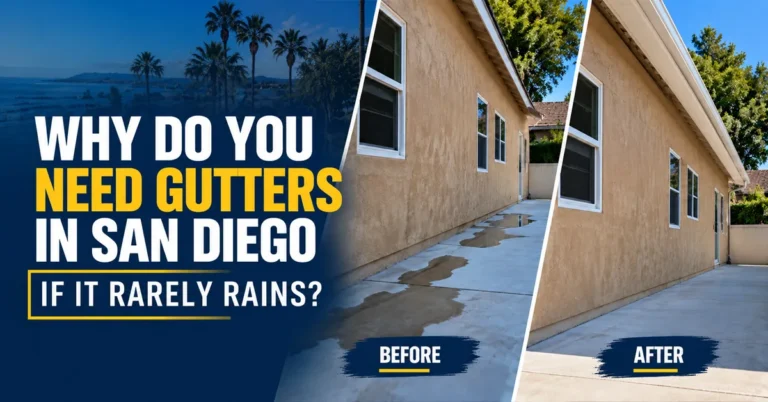
Our crew recently arrived at a home early in the morning and noticed damp-looking pavement beside a roofline that had no gutter.
We captured the scene before the work and recorded the finished white gutter installation afterward.
BEFORE: Morning Moisture Dripping From the Roof
No rain in sight, yet water was dripping from the roof onto the pavement below. Our crew captured this early-morning moisture during a visit to a San Diego home.
AFTER: A Better Way to Manage Roof Moisture
With the new gutter system installed, water running off the roof now has a designated path through the gutters and downspouts, helping reduce uncontrolled dripping along the roofline.
Coastal mornings aren’t always completely dry.
The National Weather Service’s San Diego weather guide explains how the marine layer commonly brings low clouds and coastal moisture during the night and early morning.
Dew can also form on surfaces that cool below the dew point, as described in the National Weather Service glossary.
It’s important to keep the distinction clear: the footage doesn’t establish exactly where the moisture on the pavement came from. Dew, previous rain, irrigation, or another source could be involved.
And gutters are not a solution to ordinary atmospheric humidity. Their primary job is to control rainwater draining off the roof.
Why the Way Rainwater Leaves Your Roof Matters
Not every home has the same drainage needs.
A narrow side yard, a patio directly below a roof edge, or landscaping next to the foundation can make uncontrolled roof runoff more noticeable.
A well-planned system takes more than the gutter itself into account. The gutter needs the right sizing and slope, and downspouts need to send water to an appropriate discharge area.
The City of San Diego’s guidance also emphasizes directing runoff where it can be managed without contributing to flooding or erosion.
When there’s no gutter where one would be useful, professional gutter installation can provide a practical way to manage that water while maintaining a clean finish along the roofline.
Already Have Gutters? Keeping Them Clear Is Just as Important
Long dry periods don’t stop leaves, palm debris, dirt, and roof grit from collecting in a gutter.
Sometimes the first significant rain is when homeowners discover that a downspout is blocked or water is spilling over the edge.
The City of San Diego recommends inspecting and removing debris from gutters before storm season.
If your gutters haven’t been checked recently, CWB Gutters offers professional gutter cleaning to remove buildup and check that the system can carry water as intended.
A gutter only helps when water can move through it.
Does Every House in San Diego Need Gutters?
Not necessarily the same kind or amount.
Roof design, existing drainage, grading, nearby hardscaping, and the position of downspouts all matter. Some properties may need protection along particular roof sections more than others.
If you’re unsure, start by looking at where water falls during rain and whether it collects near the house.
An on-site assessment can help determine whether new gutters, a different downspout route, cleaning, or repairs would make the most sense.
A Real Before-and-After From the CWB Gutters Crew
Our early-morning footage shows a roof edge before installation and the clean white gutter added afterward.
It’s a good reminder that gutter planning isn’t about how often the forecast shows rain. It’s about having a sensible way to handle roof runoff when the weather changes.
Contact us today for a free estimate!
📞 San Diego: (619) 742-1408