
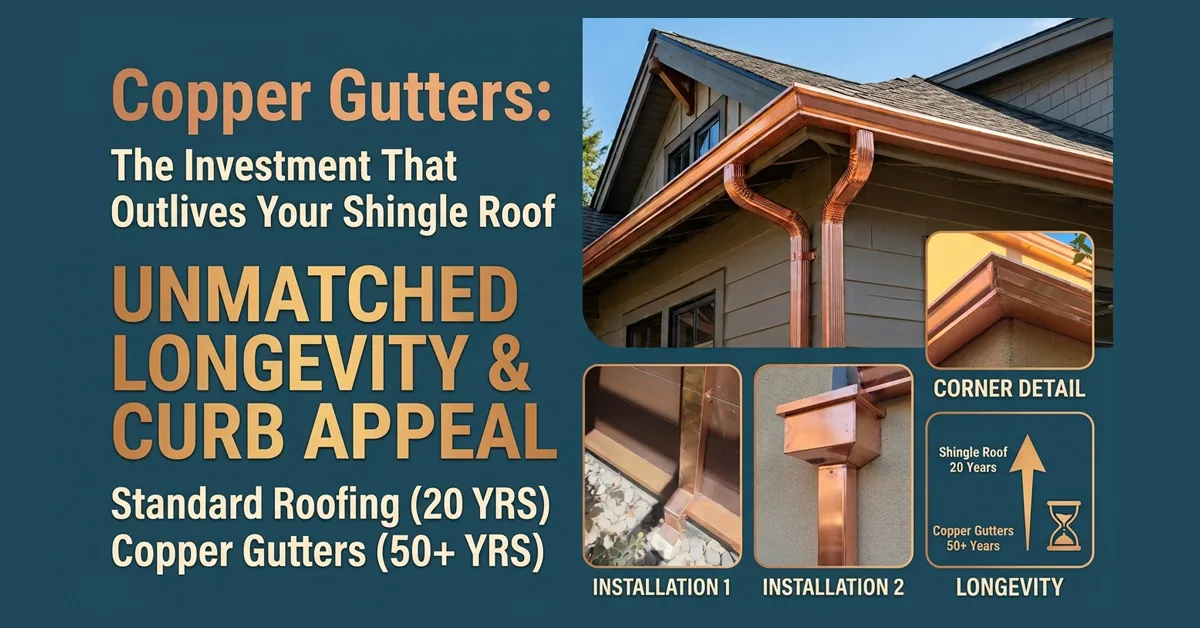
Copper Gutters: The Investment That Outlives Most Roofs
The Ultimate Guide to Premium Copper Gutter Systems
There’s a moment every homeowner has when they look up at a sagging, rust-streaked aluminum gutter and think, “There has to be a better way.”
There is. But it’s not for everyone.
Copper gutters are the quiet heavyweight of the exterior world. They don’t shout. They don’t need to. They sit on a house for 50, 60, sometimes 100 years, doing the same job they did on day one, moving water away from your foundation while slowly turning into something that looks like it belongs on a historic landmark.
And if you’re reading this, you’re probably not looking for a quick fix. You’re looking for the last gutter system you’ll ever buy.
Let’s talk about what that actually means.
Why Copper Isn’t Just a “Premium” Aluminum
Aluminum is fine. It’s light, cheap, and easy to snap together. Steel is strong but rusts. Vinyl is… well, vinyl.
Copper is a different animal entirely.
Why Copper Isn’t Just a “Premium” Aluminum. For starters, copper doesn’t rust. It corrodes, but in a way that protects itself. The green patina you see on old copper roofs and gutters isn’t decay, it’s a living shield. That layer of oxidation actually seals the metal underneath, which is why you’ll find 200-year-old copper gutters still working in Europe.
But here’s what most people don’t realize: copper is also stronger than aluminum. It can handle heavy snow loads, falling branches, and the kind of abuse that would dent or tear a standard gutter. It expands and contracts less with temperature changes, which means fewer joints pulling apart over time.
And when installed correctly, with soldered seams, not just caulk and screws, a copper gutter system becomes practically monolithic. Water can’t find a way through because there isn’t one.
The Look: From Shiny Penny to Timeless Patina
When copper gutters are first installed, they’re bright. Almost alarmingly shiny. Some homeowners love that flash of new metal against a dark roof.
Others panic a little.
The photo below shows a copper gutter we installed about three years ago, right in the middle of that transition, where the bronze tones are just starting to pick up the first hints of green at the seams.

You can also watch this short video we shot on a recent job to see how the color shifts depending on the angle of the sun:
The point is: copper doesn’t fade. It evolves. And unlike painted aluminum, which chips and peels and looks terrible after five years, copper only gets better with age.
The Catch (Because There’s Always a Catch)
Copper gutters are not cheap. If you’re comparing them to aluminum on a per-foot basis, you’ll stop reading right now.
But that’s the wrong comparison.
Think of it this way: aluminum gutters last 15 – 20 years if you’re lucky. Copper lasts 50 – 100. Over the life of your house, you’ll replace aluminum three or four times. You’ll pay for labor, disposal, and the headache of having your gutters torn off and reinstalled every couple of decades.
Copper you install once.
And then there’s the installation itself. Copper is not a DIY project. It’s also not something every gutter company knows how to do properly. Soldering copper seams requires a different skill set than snapping together aluminum sections. If the seams aren’t soldered correctly, you’ll get leaks at the exact points where you thought you were buying a premium product.
This is where most copper gutter installations fail, not because the material is flawed, but because the installer treated copper like just another metal.
What to Look for in a Copper Gutter Installation
If you’re serious about copper, here’s what separates a proper installation from a hack job:
- Soldered seams, not sealant. Copper expands and contracts. Caulk cracks. Solder flexes.
- Hangers that match the metal. Copper gutters are heavier than aluminum. They need brackets that can support the weight and are also made of copper or a compatible metal to avoid galvanic corrosion.
- Proper slope and drainage. Copper will last forever, but only if water flows through it correctly. Standing water speeds up the patina in uneven patches and can cause staining on the fascia.
- Downspouts sized and placed for real rainfall. Copper looks great, but it still has to function.
At CWB Rain Gutters, we treat copper as its own trade. It’s not just a “premium upgrade” on our price sheet. When you call us about copper, we’re sending a crew that has soldered hundreds of feet of copper seams and knows how to handle the material without denting or scratching it during installation.
If you want to see exactly how we approach installation, from the initial measurements to the final soldered joint, take a look at our gutter installation service page. We walk through the process in detail so you know what to expect before anyone shows up at your door.
Is Copper Right for Your House?
Not every house needs copper. A 1970s split-level with vinyl siding? Copper would look out of place. A modern farmhouse with a metal roof? Copper might be perfect.
Here’s a quick test: if you’re already spending money on other high-end exterior details, real stone, custom woodwork, a standing seam metal roof, then copper gutters will fit right in. They’ll elevate the whole look and quietly tell anyone who notices that you didn’t cut corners.
If your house is a starter home and you’re planning to move in five years, aluminum is probably the smarter financial move. You won’t get the return on copper in that timeframe.
But if this is your forever house? If you’re tired of replacing gutters every time a hailstorm rolls through? If you want to look up at your roofline and see something that’s as much a design feature as it is a functional component?
Copper is worth every penny.
Copper vs. Other Gutter Materials
A side-by-side look at what you're really paying for
Copper
Aluminum
Galvanized Steel
Vinyl (PVC)
Stainless Steel
Not sure which material fits your home? Talk to our installation team →
The Bottom Line
Copper gutters are an investment in the same way a slate roof or a brick exterior is an investment. They cost more up front. They last longer than you’ll probably live in the house. And they add a level of craftsmanship that you just can’t fake with paint or powder coating.
The only thing worse than paying too much for copper gutters is paying too little, and ending up with a system that leaks at the seams because the installer didn’t know what they were doing.
Do it right the first time. Your house will thank you for the next century.